
Climate change and news audiences report 2024: Analysis of news use and attitudes in eight countries
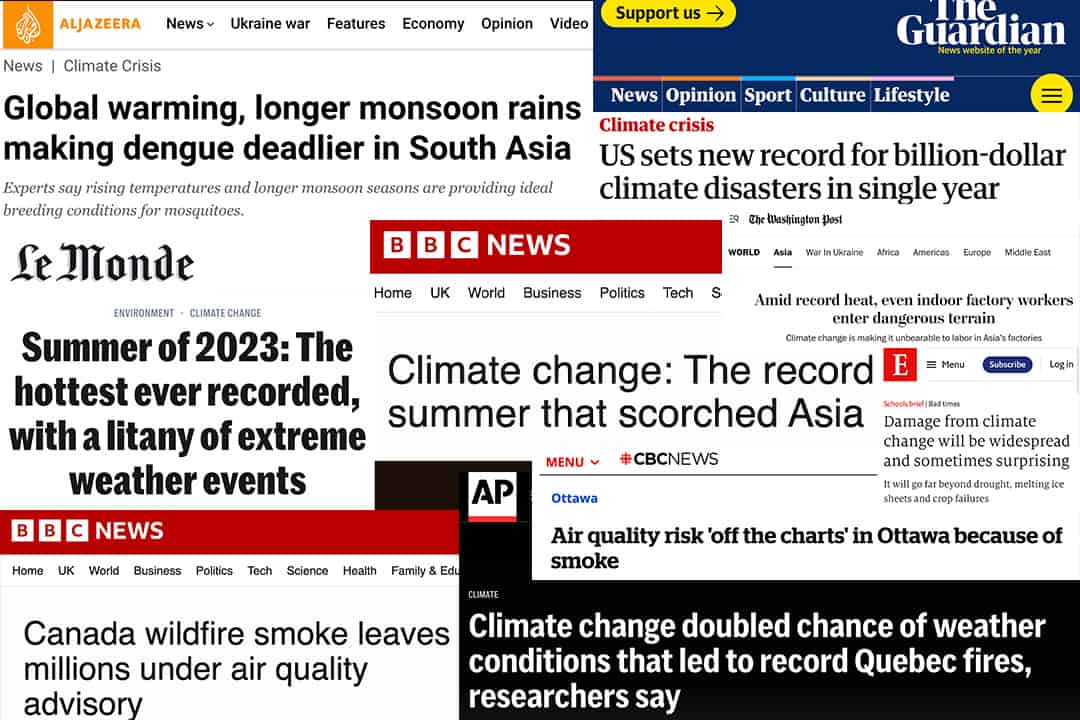
This report is part of an ongoing project to explore public engagement with news and information about climate change, and how people perceive, experience, and respond to its escalating impacts. The data come from an online survey of people in eight countries: Brazil, France, Germany, India, Japan, Pakistan, the UK, and the USA. The data were collected in November 2024.
A key theme emerging from this year’s findings is ‘climate perception inertia’ – a stagnation in public views on, attitudes to, and engagement with climate issues and information over time, despite the growing urgency of the crisis. The public understanding of risks, evaluations of institutional responses, interaction with climate news, and views on policy actions have, in most cases, remained remarkably stable since 2022, reflecting limited shifts in awareness and engagement.
Based on survey data from eight countries, we find the following related to climate change news and information consumption:
- On average across eight countries, half (50%) see, read, or hear news or information about climate change on a weekly basis – showing little change from 2022 (51%).
- Climate news and information consumption is highest in France (60%), with lower numbers in the USA (34%) where, against the backdrop of the presidential election, there was a 16 percentage point (pp) fall from 2023.
- The news media continues to be the primary way people access climate change information – ahead of documentaries, social media, and interpersonal communication – with television news (31%) and online news websites/apps (24%) the most widely used media. Video is people’s preferred format, ahead of text.
- Half (50%) say that they trust the news media on climate change – a figure that has also changed little from 2022 (52%). Scientists are by far the most trusted source of climate change information (74%) as well as the most visible source in news coverage.
- Although some argue that ‘every story is a climate story’, people are most interested in climate news that intersects with local news (52%) and weather (54%), emphasising the importance of personal relevance. People say they are less interested in climate news that intersects with entertainment coverage (25%).
Findings related to climate change misinformation:
- On average across eight countries, the proportion that think they see false and misleading information about climate change on a weekly basis is 25% – with little change from 2022 (27%).
- The highest figures for self-reported climate change misinformation exposure can be found in India (43%), with considerably lower figures in the UK (17%) and Japan (16%). However, it is crucial to keep in mind that these are perceptions and do not necessarily reflect the prevalence of misinformation in these countries.
- People associate climate misinformation with a range of different sources, with politicians and political parties (12%), government (11%), celebrities (10%), and activists (10%) topping the list.
Findings related to public awareness of and attitudes to the Conference of the Parties (COP), which overlapped with the survey fieldwork:
- We find little evidence that the occurrence of COP29 during the survey fieldwork widened access to climate change news and information, given that the proportion in the data who saw, read, or heard news or information about climate change showed little change from previous years.
- One reason for this is that, on average across eight countries, 14% say they had ‘never heard of’ COP, while 21% acknowledge they had ‘heard of it but know nothing about it’. However, a majority (61%) do claim to know at least a little about COP – though just 9% say they know ‘a lot’.
- Public perceptions of COP reveal a mixture of optimism and scepticism. While 62% believe the meeting ensures vulnerable countries’ voices are represented and 60% think it succeeds in shaping climate policy, 59% think it is influenced by big business interests.
- Younger respondents (18–34) are more likely to view COP positively, while women and older age groups express slightly less optimism about its role and success.
Findings related to extreme weather events and perceptions of risk:
- A majority of respondents in Brazil (76%) and India (65%) report experiencing heatwaves, while severe floods affect more than half of respondents in India (59%) and Pakistan (54%). Perceptions of worsening trends are consistent, with two-thirds (63%) of respondents globally believing heatwaves are becoming more severe, followed by floods (56%).
- On average across eight countries, people are more likely to think that extreme weather events are getting worse rather than better, and that the risks from them are getting higher. People have mixed views on whether their government’s handling of them is getting worse or better.
- People tend to have a favourable view of how the news media covers extreme weather events. People are more likely to think the news media does a good job than a bad job, especially when it comes to providing information in a timely manner, but less so when it comes to providing information about the underlying causes.
Findings related to public views on climate action and impacts over time:
- Over two-thirds of people in every country are concerned about the impact of climate change on people and the planet. This proportion has remained stable across the past three years, reflecting perception inertia in public concern, despite increasing climate challenges.
- Although climate concern is high across the board, it remains a politicised issue, with political ideology driving differences in concern more than other demographic variables. In 2024, concern among those on the left peaked at 91%, dropping to 77% among those on the right – widening the left–right gap.
- Views on serious climate impacts also highlight perception inertia, with the average across eight countries remaining similar in the past two years. While Brazil (+10pp to 68%) and Japan (+5pp to 52%) saw increases, Pakistan experienced a decline (−8pp to 40%).
- Over two-thirds of respondents in Brazil, and more than half in India and Pakistan, think that climate change is having a large impact on their own, their family’s, and their fellow citizens’ health. However, these numbers have changed little from 2023.
- Governments (−33), energy companies (−37), and citizens themselves (−39) are overwhelmingly seen as doing ‘too little’ to address climate change – and these perceptions have become slightly more widespread since 2022.