
Is Your Climate Advocacy Content Visible in the AI Era? A Guide to Tracking and Amplification
Strategies to monitor AI references, track AI traffic, and prioritize platforms for maximum impact in AI-driven search and content generation.
Highlights: Key Insights for AI Visibility
- Monitor AI Mentions: Specialized tools like Ahrefs Brand Radar, Otterly.AI, and Brand24 are crucial for tracking how AI models reference your content, though challenges like AI "hallucinations" persist.
- Track AI Traffic: Configure Google Analytics 4 (GA4) with custom filters (regex) or use alternatives like Ahrefs Web Analytics to identify traffic originating from AI tools like ChatGPT and Perplexity.
- Prioritize Social Platforms: Focus efforts on platforms like Reddit, X (formerly Twitter), and Quora, as their content heavily influences AI training data and AI-driven search results.
Objective 1: Tracking AI References to Your Content
Understanding How AI Models Cite Your Climate Advocacy Work
As generative AI models like ChatGPT, Google Gemini (formerly Bard), Perplexity, and Claude become primary information sources, understanding if and how they reference your organization's content is vital. This involves monitoring direct citations of your URLs and domains, as well as mentions of your brand or specific narratives within AI-generated responses.
The Challenge of AI Citations
A significant challenge is the phenomenon of "hallucinations," where AI models generate plausible but non-existent citations. This makes verification crucial. Furthermore, many AI developers do not fully disclose their training datasets, adding a layer of opacity to tracking direct inclusion.
Tools for Tracking AI Mentions and Citations
Several tools are emerging to help organizations monitor their presence in the AI landscape:
- Ahrefs Brand Radar: Tracks brand mentions specifically within Google's AI Overviews and helps analyze competitive visibility in AI-generated search results.
- Otterly.AI: Offers automated visibility into how brands appear across multiple AI platforms (Google AI Overviews, ChatGPT, Perplexity), tracking mentions, citations, and sentiment.
- Trackerly.ai: Monitors brand mentions and sentiment across AI providers like ChatGPT, Google Gemini, and Anthropic's Claude, providing daily updates.
- Profound: Uses various prompts to identify which brands are recommended by AI search tools (ChatGPT, Perplexity, Copilot), showing specific URLs cited.
- Brand24: Provides AI-powered social listening that can extend to tracking mentions in AI-generated content across millions of sources. It allows reverse searching to see how AI responds to questions about your brand.
- SpyFu: Offers features to monitor brand mentions specifically within ChatGPT responses, facilitating competitive analysis.
- CiteSure / Trinka AI / MyBib: Tools focused more on verifying the accuracy of AI-generated citations rather than tracking brand mentions, but useful for validating references when found. Sourcely.net aggregates lists of such tools.
Selecting the Right Tools for Non-Technical Teams
For teams without deep technical expertise, prioritize tools with user-friendly interfaces, clear dashboards, comprehensive reporting, and minimal setup complexity. Based on the descriptions:
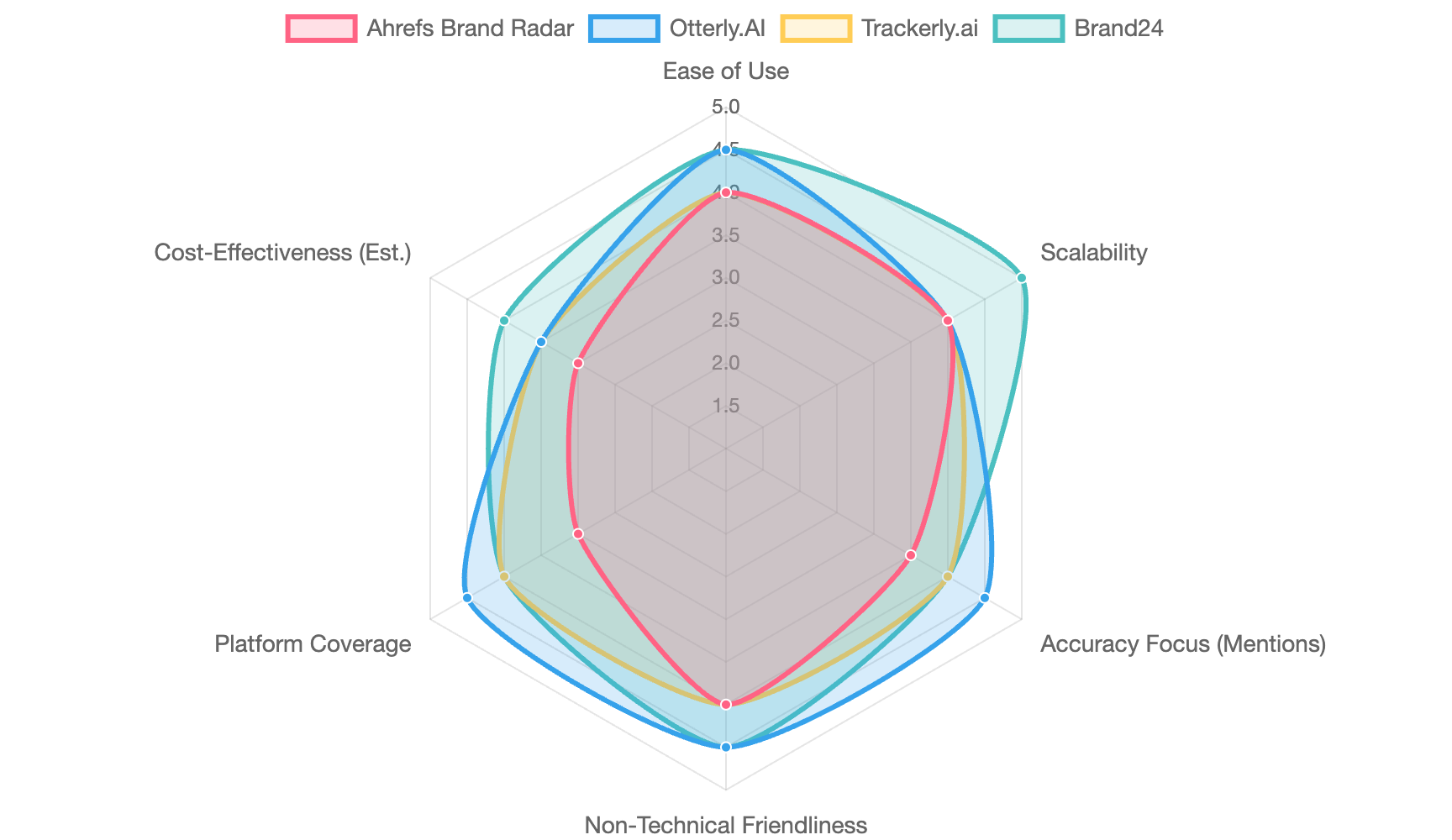
- Otterly.AI and Brand24 appear particularly suitable due to their automated tracking, clear dashboards, and focus on accessibility for non-technical users.
- Ahrefs Brand Radar is integrated within a familiar SEO platform, potentially easing adoption for teams already using Ahrefs.
- Trackerly.ai also emphasizes instant insights and customization, suggesting ease of use.
- Profound and SpyFu might offer deeper insights but could require more configuration or analysis.
Consider using a combination of tools for a more robust monitoring framework. Scalability often depends on the subscription tier, but most cloud-based tools offer scalable solutions.
Comparative Analysis of AI Mention Tracking Tools
Visualizing Key Features for Tool Selection
Choosing the right tool depends on your specific needs regarding ease of use, scalability, accuracy, cost, and suitability for non-technical teams. The radar chart below offers a comparative perspective based on available information for some prominent tools mentioned. Scores are relative estimations (1-5, higher is better) to guide selection.
Objective 2: Detecting AI-Origin Traffic in Analytics
Identifying Visitors Referred by AI Tools
Measuring the impact of AI visibility requires understanding if traffic to your website originates from users interacting with AI tools. Standard analytics platforms are adapting, but detection isn't always straightforward.
Google Analytics 4 (GA4) Capabilities and Limitations
GA4 can be configured to identify traffic from known AI platforms. This typically involves setting up a custom channel group (e.g., named "AI Traffic") using regular expressions (regex) to filter traffic based on referral sources.
Steps in GA4:
- Navigate to Admin > Data Display > Channel Groups.
- Create a new channel group or modify an existing one.
- Define a new channel (e.g., "AI Traffic").
- Set the condition to "Source / medium" matches regex (or "Source" matches regex).
- Use a regex pattern to capture known AI domains. A comprehensive example provided by Ahrefs and other sources is:
(.*chatgpt\.com|.*openai\.com|.*perplexity.*|.*gemini\.google\.com|.*bard\.google\.com|.*copilot\.microsoft\.com|.*claude\.ai|.*writesonic\.com|.*copy\.ai|.*deepseek\.com|.*huggingface\.co.*)
Limitations:
- Many AI tools obscure or don't pass referral data, leading to underreporting. Traffic might be misclassified as "Direct" or another category.
- The list of AI domains needs regular updating as new tools emerge or change URLs.
- Current estimates suggest AI-driven traffic is a small percentage (around 0.1%) of total website traffic, but this figure is likely underestimated and expected to grow.
Alternatives and Enhancements
- Ahrefs Web Analytics: Pitched as a privacy-friendly alternative to GA4, it offers pre-built reports specifically for AI traffic. It boasts faster, near real-time insights (within minutes vs. GA4's potential 24-48 hour delay) and can provide detailed breakdowns of AI sources, top landing pages receiving AI traffic, and associated engagement metrics.
- Server Logs & User-Agent Tracking: While less common in standard analytics dashboards, server logs might capture specific AI user-agents like
PerplexityBotorChatGPT-User. GA4 or other analytics tools can potentially filter based on these if they are present in the collected data. However, consistent logging and identification across all AI tools are not standard practice, making this method less reliable globally.
Objective 3: Prioritizing Social Media for AI Visibility
Which Platforms Best Amplify Your Message in the AI Ecosystem?
AI models, particularly LLMs, are trained on vast datasets, including large swathes of the public internet and social media content. Strategic presence on influential platforms can increase the likelihood that your climate advocacy narratives are included in AI training data and surfaced in AI-generated responses and AI-influenced search results (like Google's AI Overviews).
Identifying High-Influence Platforms
Research and analysis suggest certain platforms disproportionately influence AI training datasets and outputs:
- Reddit: Frequently cited due to its vast collection of in-depth discussions, niche communities (subreddits), and conversational data covering diverse topics. Its structure often provides context AI models find valuable.
- X (formerly Twitter): Its real-time nature and public discourse make it a significant source for training data on current events, trending topics, and public sentiment.
- Quora: The question-and-answer format aligns well with how users query AI models. High-quality answers on Quora can directly influence AI responses and often rank well in search results.
- Wikipedia: While not a social media platform, its structured, factual content is a foundational data source for many LLMs. Ensuring climate change topics are accurately represented here is crucial.
- TikTok: Highly influential for cultural trends and visual content, but its direct impact on training text-based LLMs is likely lower than text-heavy platforms. However, narratives popularized on TikTok can shape broader discourse that eventually filters into text data.
Factors Driving AI Inclusion and Visibility
Several factors determine whether your content gets picked up and prioritized by AI systems:
- Content Quality and Format: High-quality, informative, well-structured, and factual content is preferred. Formats that match user queries (like Q&A on Quora or detailed explanations on Reddit) are effective.
- Engagement Signals: High interaction rates (upvotes, likes, shares, comments) signal relevance and authority to algorithms, increasing the likelihood of content being included or surfaced.
- Metadata and SEO: Clear titles, descriptions, tags, and structured data (like schema markup) help AI understand context and relevance, especially in AI-driven search.
- Backlinks and Authority: Content linked from reputable, high-authority sources is deemed more trustworthy and is more likely to be referenced by AI, similar to traditional SEO. Consistency of mentions across platforms also helps.
Social Media Prioritization Matrix
Given limited capacity, focus efforts where influence and impact are highest. This matrix provides a simplified comparison:
| Platform | Influence on AI Training Data | SEO / AI Search Impact | Content Fit for Climate Advocacy | Engagement Potential |
|---|---|---|---|---|
| High | Moderate-High (indexed, community links) | High (niche subs, in-depth discussion) | High (within specific communities) | |
| X (Twitter) | High (real-time, public discourse) | Moderate (indexed, good for trending) | High (rapid response, campaigns) | Variable (requires consistent activity) |
| Quora | Moderate-High (Q&A format) | High (answers rank well) | High (expert positioning, detailed answers) | Moderate |
| Wikipedia | Very High (foundational data) | Very High (ranks consistently) | High (factual representation) | N/A (collaborative editing) |
| TikTok | Low-Moderate (primarily visual) | Low (indirect influence) | Moderate (awareness, simple messages) | High (potential for virality) |
| Moderate (professional content) | Moderate (indexed, B2B focus) | Moderate (policy, corporate angles) | Moderate |
Prioritization Recommendation: Focus primarily on Reddit, X, and Quora for text-based influence on AI models and search. Dedicate resources to ensuring factual accuracy on Wikipedia. Use other platforms like TikTok or LinkedIn based on specific campaign goals.
Visualizing Your AI Visibility Strategy
A Mindmap of Key Action Areas
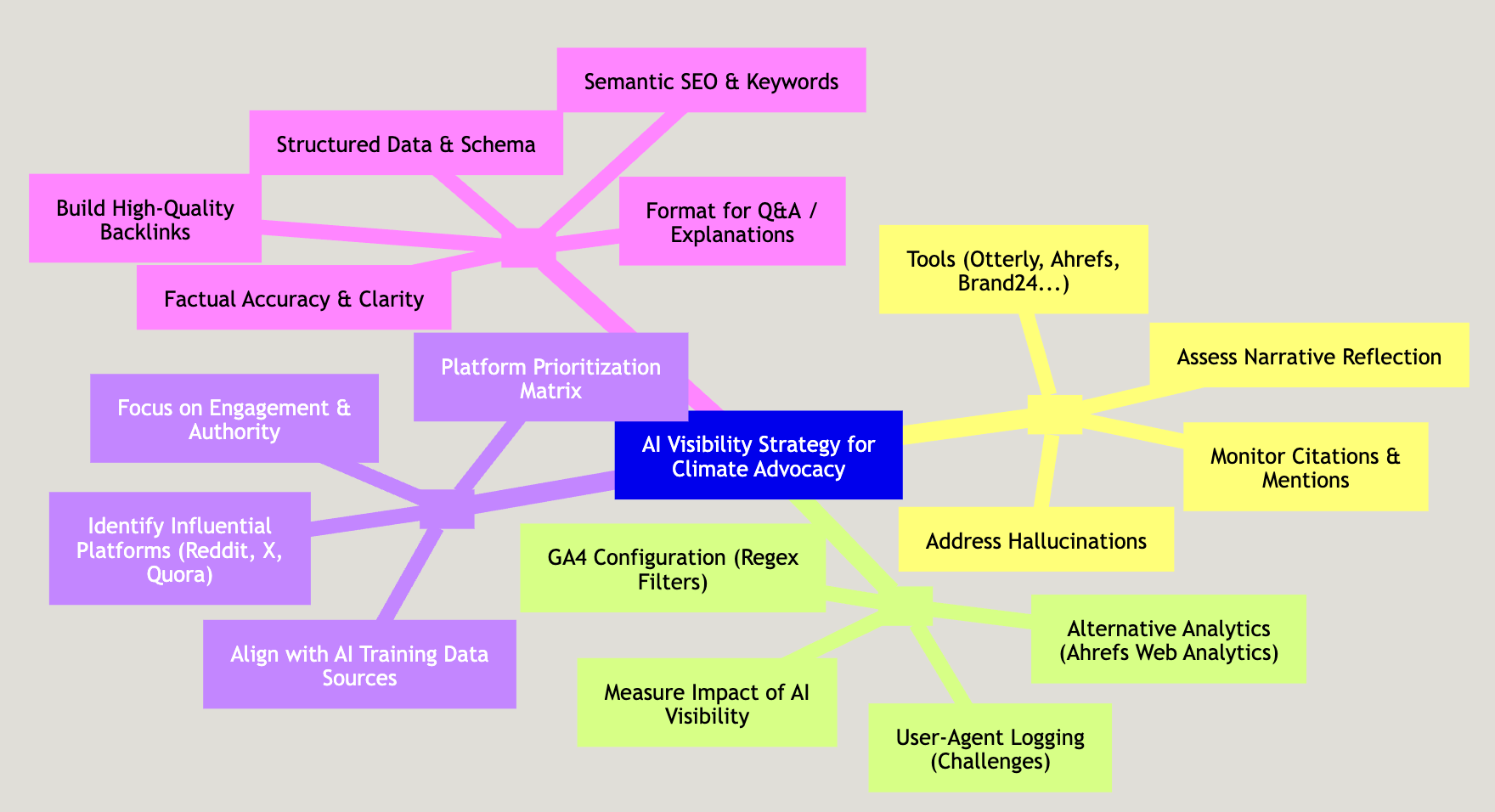
To effectively leverage AI's impact, a multi-faceted strategy is required. This mindmap outlines the interconnected components discussed: tracking content references, analyzing traffic sources, prioritizing social platforms, and optimizing content.
| Action Area | Key Tactics |
|---|---|
| 1. Track AI Content Referencing |
|
| 2. Analyze AI Traffic Sources |
|
| 3. Prioritize Social Media |
|
| 4. Optimize Content for AI |
|
Understanding User Perceptions of AI in Search
Visual Insights into AI Search Adoption
As AI integrates more deeply into search engines, understanding user trust and interaction patterns is crucial. The images below, sourced from recent surveys and analyses, shed light on how consumers perceive and use AI-generated search results. This context helps tailor advocacy content for platforms where users are increasingly encountering AI-driven answers, highlighting the importance of ensuring your organization's narrative is accurately represented.
Tactical Recommendations: Optimizing for AI Discovery
Actionable Steps for Short-Term Wins and Long-Term Strategy
Short-Term Actions (Implement Now)
- Audit Existing Content: Use SEO tools (like Ahrefs, SEMrush) and AI mention trackers (like Otterly.AI, Brand24) to baseline your current visibility and identify top-performing content potentially referenced by AI.
- Configure AI Traffic Tracking: Set up GA4 custom channel groups with the regex filter provided earlier, or explore Ahrefs Web Analytics for immediate AI traffic insights. Monitor this data regularly.
- Pilot Platform Focus: Select one or two high-priority platforms (e.g., Reddit, Quora) and publish targeted content optimized for AI discovery (clear answers, structured format). Track mentions related to this content.
- Basic Content Optimization: Review top content pages. Ensure clear headings (H1, H2, H3), concise paragraphs, and factual accuracy. Add FAQ sections addressing common climate questions relevant to your work.
- Metadata Review: Ensure key pages have descriptive titles and meta descriptions optimized for clarity and relevance.
Long-Term Strategy (Build Towards)
- Develop AI-Friendly Content Strategy: Create content specifically designed to answer questions users might ask AI about climate change. Use structured data (Schema.org markup for Articles, FAQs, Organization) extensively to provide context to AI crawlers.
- Build Authority and Backlinks: Focus on earning high-quality backlinks from reputable environmental, news, and academic domains. Authority signals trust to AI models.
- Consistent Platform Engagement: Maintain an active, authoritative presence on prioritized platforms (Reddit, X, Quora). Engage in relevant discussions, share valuable insights, and build community.
- Monitor and Adapt: Continuously track AI mentions and traffic using chosen tools. Analyze which content formats and platforms yield the best results and adapt your strategy accordingly. Stay updated on AI platform changes (new tools, different algorithms).
- Invest in Scalable Tools & Training: As AI's role grows, invest in robust monitoring tools (like Otterly.AI, Ahrefs) and ensure relevant team members (even non-technical ones) are trained to use them effectively.
- Ethical Considerations & Disinformation: Actively participate in initiatives promoting AI transparency and combating climate disinformation potentially amplified by AI. Ensure your own content is nuanced and avoids overly simplistic narratives that could be misconstrued.
Advanced Measurement Tactics for AI SEO Success
To go beyond foundational monitoring, these advanced methods help climate advocacy teams quantify influence and visibility within AI systems more accurately:
1. Keyword/Prompt Testing in AI Platforms
- What's new: Set up a custom prompt library (e.g. “best climate advocacy org,” “top NGO on climate misinformation”) and run these queries regularly across ChatGPT, Gemini, Perplexity.
- Why it matters: This gives you position and presence tracking—how often and in what way your brand is appearing.
- How to do it: Use Google Sheets + API access (or Trackerly.ai/Profound) for prompt automation and tracking results over time.
2. "Share of Model" Metric (Emerging Concept)
- What's new: Introduced by Jellyfish, this is about calculating how often your brand is cited versus competitors across LLMs.
- Why it matters: It's the AI SEO equivalent of Share of Voice or SERP dominance in classic SEO.
- How to do it: Use prompt tracking and mention detection tools to tally presence frequency.
3. Branded Search Uplift as a Proxy
- What's new: Track branded keyword search volume in Google Search Console.
- Why it matters: If AI is recommending your org, more people will search for your name shortly after.
- How to do it: Set up alerts or dashboards to correlate spikes with known AI mentions.
4. Survey-Based Attribution for AI Traffic
- What's new: Include “Where did you hear about us?” survey options that list AI tools (ChatGPT, Perplexity, Gemini, etc.).
- Why it matters: Referral data is often hidden; direct customer feedback provides real attribution.
- How to do it: Add to checkout flows, newsletter signup, or engagement forms.
5. Realistic Limitations and Data Lag
- What's new: AI data ingestion is slow and inconsistent—mentions might not surface in ChatGPT for 4–14 months.
- Why it matters: Prevents premature optimization panic. You need to think in long timelines and focus on authority building over time.
- Strategic adjustment: Treat AI SEO as a slow-burn process like Wikipedia optimization, not a rapid-feedback SEO channel.
Featured Video: Tracking AI Overview Brand Mentions
Understanding Ahrefs Brand Radar
Monitoring how your brand or organization appears in AI-generated search results, like Google's AI Overviews, is becoming increasingly important. This video from Ahrefs introduces their Brand Radar tool, designed specifically for this purpose. It explains how the tool helps track mentions of your brand in AI Overviews, compare your visibility against competitors, and identify queries where AI summaries are being shown. Understanding these tools is a key part of implementing the strategies discussed in this brief, particularly for Objective 1 (AI Referencing) and understanding AI's impact on search visibility (Objective 3).
Frequently Asked Questions (FAQ)
What are AI 'hallucinations' and why do they matter for tracking citations?
AI hallucinations refer to instances where generative AI models produce outputs that are factually incorrect, nonsensical, or entirely fabricated, yet present them confidently as if they were accurate. In the context of citations, an AI might invent a source, misattribute information, or create a plausible-looking but non-existent URL. This matters because simply finding a mention of your organization or URL in an AI output doesn't guarantee it's based on your actual content. Verification using tools or manual checks is necessary to confirm accurate referencing versus hallucination.
Can GA4 perfectly track all traffic coming from AI tools?
No, GA4 cannot perfectly track all AI-origin traffic. While configuring custom channels with regex filters helps capture traffic from known AI domains (like chatgpt.com, perplexity.ai), many AI tools do not pass referral information when users click links within their interfaces. This means a significant portion of AI-driven traffic might be misclassified as 'Direct' or another source. Using specialized tools like Ahrefs Web Analytics alongside GA4 and regularly updating regex filters can improve tracking, but some undercounting is currently unavoidable due to limitations in referral data passed by AI platforms.
Why are platforms like Reddit and Quora considered particularly influential for AI training?
Reddit offers vast amounts of text-based, conversational data across countless specific topics (subreddits). This includes discussions, opinions, explanations, and personal experiences, providing diverse linguistic patterns and world knowledge valuable for training LLMs. Quora's structured question-and-answer format directly mirrors how users interact with AI chatbots. High-quality, detailed answers provide clear information pairs (question + answer) that are useful for training AI models to respond effectively to user queries. Both platforms contain content that is frequently updated and reflects real-world language use and knowledge.
Besides content, what other factors significantly impact AI visibility?
While high-quality content is fundamental, other factors play crucial roles:
- Authority and Trust: Similar to traditional SEO, AI algorithms prioritize content from sources deemed authoritative and trustworthy. This is often signaled by high-quality backlinks from reputable websites and consistent mentions across the web.
- Engagement Signals: High levels of user engagement on social platforms (likes, shares, upvotes, comments) indicate content relevance and value, making it more likely to be picked up by AI training processes or surfaced in AI results.
- Metadata and Structured Data: Clear metadata (titles, descriptions) and structured data (schema.org markup) help AI systems understand the context, topic, and key information within your content, improving its discoverability and potential for accurate referencing.
- Recency and Frequency: For certain topics, particularly current events, newer content and consistent publishing can be favoured by AI models seeking up-to-date information.
Frequently Asked Questions (FAQ)
What are AI 'hallucinations' and why do they matter for tracking citations?
AI hallucinations refer to instances where generative AI models produce outputs that are factually incorrect, nonsensical, or entirely fabricated, yet present them confidently as if they were accurate. In the context of citations, an AI might invent a source, misattribute information, or create a plausible-looking but non-existent URL. This matters because simply finding a mention of your organization or URL in an AI output doesn't guarantee it's based on your actual content. Verification using tools or manual checks is necessary to confirm accurate referencing versus hallucination.
Can GA4 perfectly track all traffic coming from AI tools?
No, GA4 cannot perfectly track all AI-origin traffic. While configuring custom channels with regex filters helps capture traffic from known AI domains (like chatgpt.com, perplexity.ai), many AI tools do not pass referral information when users click links within their interfaces. This means a significant portion of AI-driven traffic might be misclassified as 'Direct' or another source. Using specialized tools like Ahrefs Web Analytics alongside GA4 and regularly updating regex filters can improve tracking, but some undercounting is currently unavoidable due to limitations in referral data passed by AI platforms.
Why are platforms like Reddit and Quora considered particularly influential for AI training?
Reddit offers vast amounts of text-based, conversational data across countless specific topics (subreddits). This includes discussions, opinions, explanations, and personal experiences, providing diverse linguistic patterns and world knowledge valuable for training LLMs. Quora's structured question-and-answer format directly mirrors how users interact with AI chatbots. High-quality, detailed answers provide clear information pairs (question + answer) that are useful for training AI models to respond effectively to user queries. Both platforms contain content that is frequently updated and reflects real-world language use and knowledge.
Besides content, what other factors significantly impact AI visibility?
While high-quality content is fundamental, other factors play crucial roles:
- Authority and Trust: Similar to traditional SEO, AI algorithms prioritize content from sources deemed authoritative and trustworthy. This is often signaled by high-quality backlinks from reputable websites and consistent mentions across the web.
- Engagement Signals: High levels of user engagement on social platforms (likes, shares, upvotes, comments) indicate content relevance and value, making it more likely to be picked up by AI training processes or surfaced in AI results.
- Metadata and Structured Data: Clear metadata (titles, descriptions) and structured data (schema.org markup) help AI systems understand the context, topic, and key information within your content, improving its discoverability and potential for accurate referencing.
- Recency and Frequency: For certain topics, particularly current events, newer content and consistent publishing can be favoured by AI models seeking up-to-date information.
References
- How to Track and Analyze Your AI Traffic - Ahrefs Blog
- Ahrefs Brand Radar Tool - Ahrefs
- Otterly.AI: AI Search Monitoring - Otterly.AI
- AI Brand Mention & Sentiment Tracking - Trackerly.ai
- AI Social Listening Tool - Brand24
- Monitor Brand Visibility Across AI Search Channels - Search Engine Land
- How to Get Your Brand Mentioned by AI Tools - Stan Ventures
- Citation Verification Tools - CiteSure
- Top 10 AI Tools for Citations in 2025 - Sourcely.net